


Struggling For Funding? 10 Things Every UK Developer Should Know About Debt + Equity Capital Stacks
If you're a UK property developer who's been told "no" by a lender recently, you're not alone. In fact, nearly 60% of development projects are rejected at first application, not because the deal is bad, but because the funding structure is wrong.
Here's the thing most developers don't realise: getting property development finance in the UK isn't just about finding one lender anymore. It's about stacking multiple funding sources, debt and equity, in the right order to make your project bankable.
So if you're struggling to get your projects off the ground, this one's for you. We're breaking down the 10 most important things you need to know about debt and equity finance property stacks, and how to use them to close funding gaps for good.
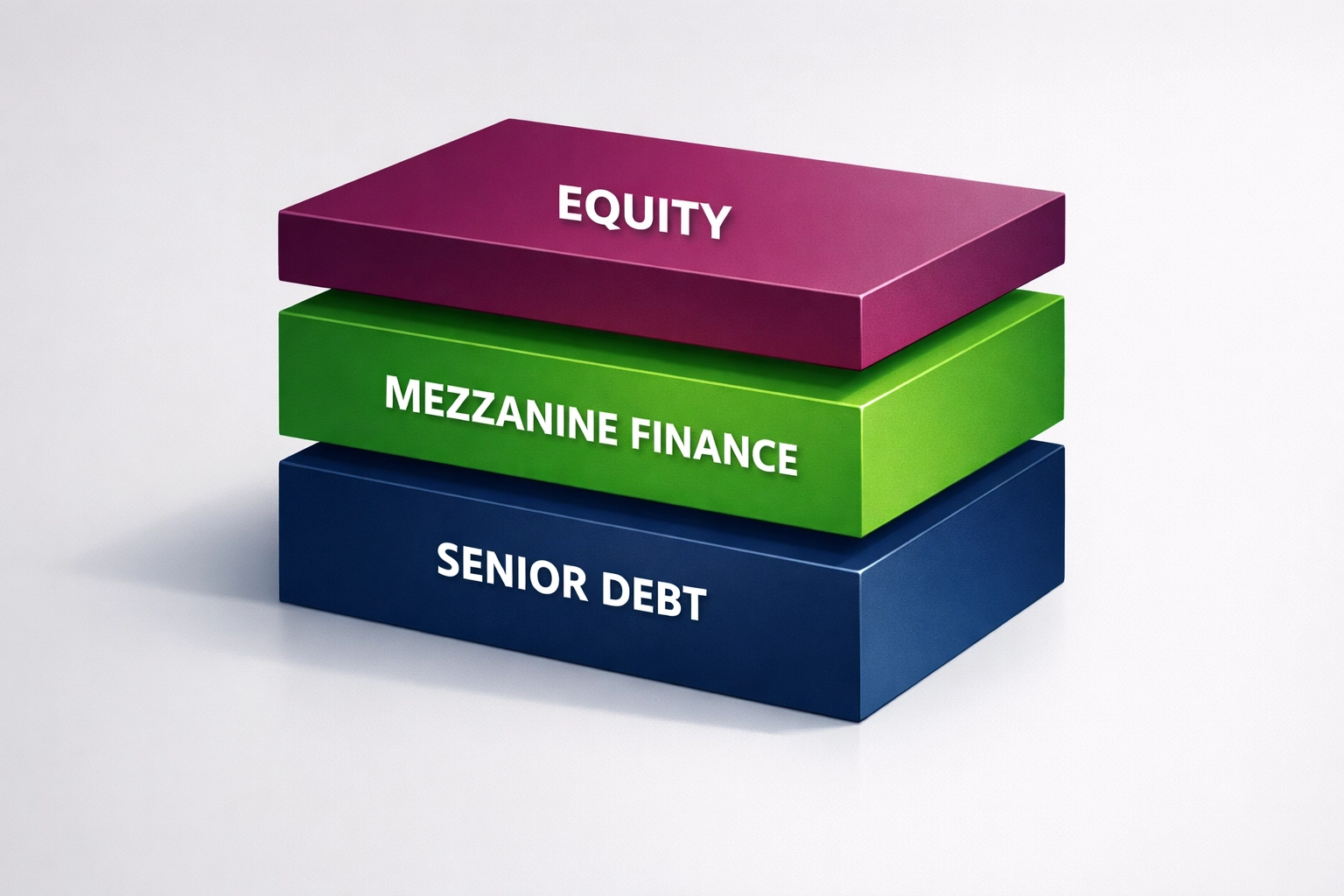
1. What Actually Is a Debt & Equity Capital Stack?
Let's start with the basics. A debt and equity capital stack is just a fancy term for all the different layers of funding that finance your project, from the cheapest money at the bottom (senior debt) to the most expensive at the top (equity).
Think of it like a sandwich:
Senior Debt (the bottom layer): Your primary lender, usually 60–70% of project costs at the lowest interest rate.
Mezzanine Debt (the middle): A secondary lender who fills the gap between senior debt and equity, usually at a higher rate.
Equity (the top layer): Your own cash or investor capital, the riskiest money, but the most flexible.
Most developers think they just need "a loan." But in 2026, successful funding for property developers means knowing how to layer these sources strategically.
2. The 70% LTV Problem (And Why You Need More Than One Lender)
Here's a scenario we see all the time: you've got a £500,000 project, and your lender offers 70% Loan-to-Value (LTV). That's £350,000. Great, right?
Wrong. Because you still need £150,000 to make up the difference, and most developers don't have that sitting in the bank.
This is where debt and equity stacks come in. Instead of walking away from the deal, you could:
Keep the senior debt at £350,000 (70% LTV)
Add £75,000 in mezzanine finance (15%)
Fill the final £75,000 with equity (15%)
Suddenly, your "unfundable" project becomes doable.
3. Senior Debt: The Foundation of Every Stack
Your senior debt is always the first piece of the puzzle. This is the lender who gets paid back first if things go wrong, which is why they offer the lowest interest rates (typically 6–9% in today's market).
Senior lenders will usually cover:
60–70% of Gross Development Value (GDV) for experienced developers
50–60% GDV for first-time developers
Sometimes up to 70% of costs (not value), depending on the project
The key is to maximise your senior debt first before you start looking at more expensive options. It's the cheapest money you'll get.

4. Mezzanine Finance: The Flexible Middle Layer
If senior debt doesn't cover enough, mezzanine finance is your next stop. This is a second-charge loan that sits between senior debt and equity, typically covering an additional 10–20% of costs.
Mezzanine lenders charge higher rates (usually 10–15%) because they take on more risk. But here's why it's worth it:
It's still cheaper than giving away equity
It's non-dilutive (you keep 100% ownership)
It gives you breathing room without needing huge cash reserves
At PropFundrs, we help developers structure these multi-layered funding stacks all the time, because the reality is most projects need more than one debt source to work.
5. When Equity Makes Sense (And When It's Too Expensive)
Let's talk about equity. This is where you bring in investors who own a slice of your project in exchange for capital.
Equity is great when:
You're a first-time developer and can't access enough debt
You want to scale quickly without tying up all your own cash
The project has massive upside (20%+ returns) that justifies sharing profits
But equity is expensive. If you're giving away 30% of a project that delivers £100,000 profit, you've just handed over £30,000. Compare that to mezzanine debt at 12% interest on £75,000 (£9,000 total cost), and you can see why layering debt before equity often makes more sense.
6. The Order Matters: How to Sequence Your Stack
Here's a mistake we see constantly: developers approach equity investors before they've exhausted their debt options. That's backwards.
The correct sequencing for most UK property development projects is:
Maximise senior debt (60–70% LTV)
Add mezzanine finance if needed (10–20%)
Fill the final gap with equity or personal funds (10–20%)
Why? Because you want the cheapest money at the bottom and the most expensive at the top. It's literally a case of working your way up the capital stack.

7. The Real Reason Most Developers Get Rejected
It's not the deal. It's the presentation.
Lenders and investors want to see a structured funding pack that clearly shows:
How much you're borrowing and from whom
What the capital stack looks like
Where their money sits in the repayment hierarchy
Your exit strategy and risk mitigation
Without that clarity, even a brilliant project looks risky. This is exactly why we created our Funding Packs service, because the difference between "yes" and "no" is often just better paperwork.
8. How to Calculate Your Equity Requirement
Let's get tactical. Here's a simple formula to work out how much equity (or personal capital) you'll actually need:
Total Project Costs – Senior Debt – Mezzanine Debt = Equity Requirement
Example:
Total costs: £500,000
Senior debt (65%): £325,000
Mezzanine (15%): £75,000
Equity needed: £100,000
If you don't have £100,000 personally, you'll need to bring in investors. That's when you need to decide: are you willing to give away some of your profits to fill that gap?
9. The Hidden Costs: Interest vs Profit Share
Here's something most developers overlook when comparing debt vs equity: the true cost over time.
Debt has a fixed cost. A 12% annual rate on £100,000 = £12,000/year. That's it.
Equity is variable. A 25% profit share on a £200,000 profit = £50,000. Ouch!
Yes, debt requires servicing during the build. But equity can end up costing you far more if the project performs well. Always run the numbers both ways before you decide which route to take.

10. How to Present a Blended Stack to Lenders
Right, so you've figured out your ideal capital stack. Now you need to pitch it.
Here's what lenders and investors want to see in a blended funding proposal:
A clear sources-and-uses table showing exactly where every £1 is coming from and going to
Your personal skin in the game (even 5–10% equity from you shows commitment: usually any equity investor will also want to see this)
Exit strategy multiple options with realistic timelines for repayment
Risk mitigation (read more about that here)
The developers who get funded in 2026 aren't necessarily the ones with the best deals: they're the ones who package their deals properly. That's the real competitive advantage.
The Bottom Line: It's Not About Finding One Lender: It's About Building the Right Stack
If you've been struggling to secure funding for property developers, it's probably not because your project isn't good enough. It's because you've been thinking about finance the wrong way.
The most successful developers in the UK right now aren't just hunting for one big lender. They're strategically layering senior debt, mezzanine finance, and equity to create funding structures that work: even in a high-interest environment.
At PropFundrs, we've helped our clients secure over £3.3 million in funding by focusing on one simple principle: we invest in developers, not just bricks and mortar. Because when you get the structure right, the funding follows.
Need help building your capital stack? Get in touch with us, and let's turn your "unfundable" project into a funded one.
Comments